
For diagnostics and data platform companies
Embed TrialMind in your platform
Let your customers define patient groups and run analyses inside your platform, under your brand.
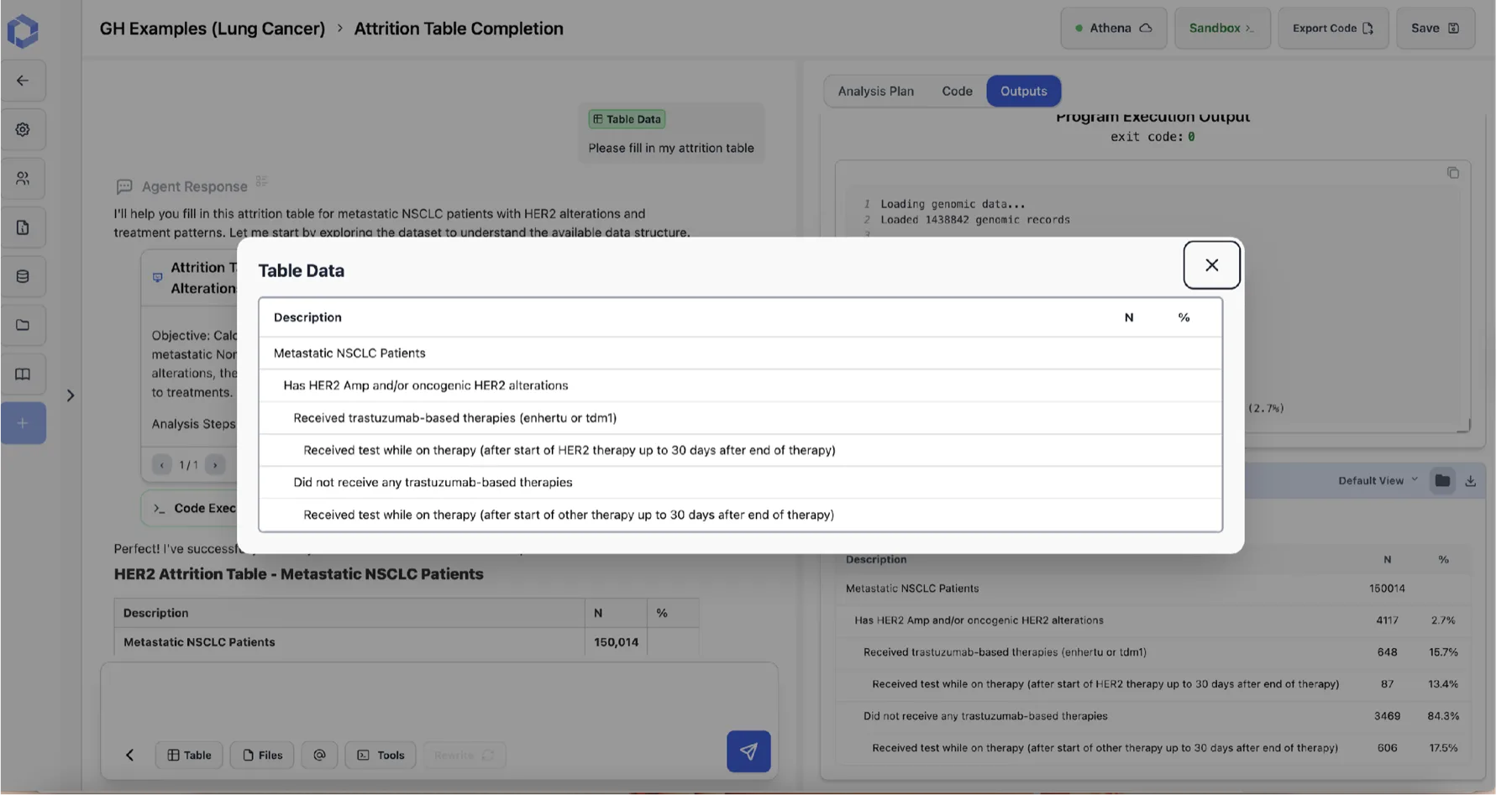
A feasibility analysis of the kind your platform could offer customers.
What platform teams get
Delivered under your brand
Your customers want feasibility, cohort extraction, and outcome analyses, not raw data access. TrialMind delivers these under your brand.
Weeks to launch
You do not need to build a clinical analytics team. The agents and tool infrastructure already exist, so embedding takes weeks.
Runs where the data is
TrialMind deploys into your customer's environment, and raw data never leaves it. This is part of the architecture, not negotiated deal by deal.
What each one includes
- REST application programming interface (API) and Model Context Protocol (MCP) server access
- White-label or co-branded, your choice
- Fits your product roadmap rather than ours
- Your customer relationship stays yours
- Production agent infrastructure already built
- A clinical MCP tool library available from the start
- No clinical domain team to recruit first
- Differentiates your data from similar data sources
- Runs inside the customer's environment
- Raw records never leave their control
- Audit trails on every analysis, because outputs reach submissions
- Security documentation you can share with their review board
Security and data handling
Data partnerships often stall on where data goes and whether the analysis holds up. TrialMind addresses both in its architecture.
Raw data stays in place
By default, TrialMind is deployed in the customer's environment, which addresses the main concern in data partnerships.
Full audit trails
Customers take these outputs into regulatory submissions, so every analysis carries reproducible provenance.
Built around your roadmap
We plan the integration around your product and release schedule.
Integration details
- Integration
- REST application programming interface (API) for product integration; Model Context Protocol (MCP) server to call the agents as tools from your own assistant
- Branding
- White-label or co-branded
- Capabilities
- Feasibility, cohort extraction, and outcome analysis on your data asset
- Deployment
- Inside the customer's environment; raw records never leave it
- Time to launch
- Weeks, because the agents and clinical MCP tool library already exist
- Customer relationship
- Yours; biopharma customers onboarded through your product are attributed to you
Frequently asked questions
How does the integration actually work?
There are two options: a REST application programming interface (API) for conventional product integration, and a Model Context Protocol (MCP) server if you want to call the agents as tools from your own assistant or workflow layer. Most partners start with the API and add MCP once they know which workflows their customers use most.
Can we white-label it?
Yes. White-label or co-branded, whichever fits your positioning, so it appears as part of your product rather than as a visible third-party component.
Where does our customers' data go?
It stays where it is. TrialMind deploys into the customer's own environment and raw records never leave it. This is usually the first question biopharma customers ask, and the deployment model answers it.
How long does an embed take?
Weeks rather than years, because the agents and tool infrastructure already exist. What varies is the depth of integration with your platform, not the time to build clinical analytics capability from scratch.
Who owns the customer relationship?
You do. We are the layer inside your product, and we attribute any biopharma customer onboarded through it. We are explicit about this at the start so that neither side is guessing later.
What if we later build this ourselves?
That is reasonable to consider, and we would rather structure the agreement with that in mind. We ask for a clear commercial framework across the workstreams.
Discuss an integration
We agree on integration depth, deployment, and commercial terms at the start.