TrialMind for Biometrics & Biostatistics
From trial design to study tables
Compare trial designs, then prepare analysis datasets, SAS and R code, and study tables for your team to review, with an audit trail from source record to table.
- To draft eligibility criteria for a new protocol
- Months → days1
- To draft eligibility criteria for a new protocol
Biostatistics and trial design workflows
Trial design work before the SAP is final, and statistical programming after. Each step is reviewed before the next one runs.
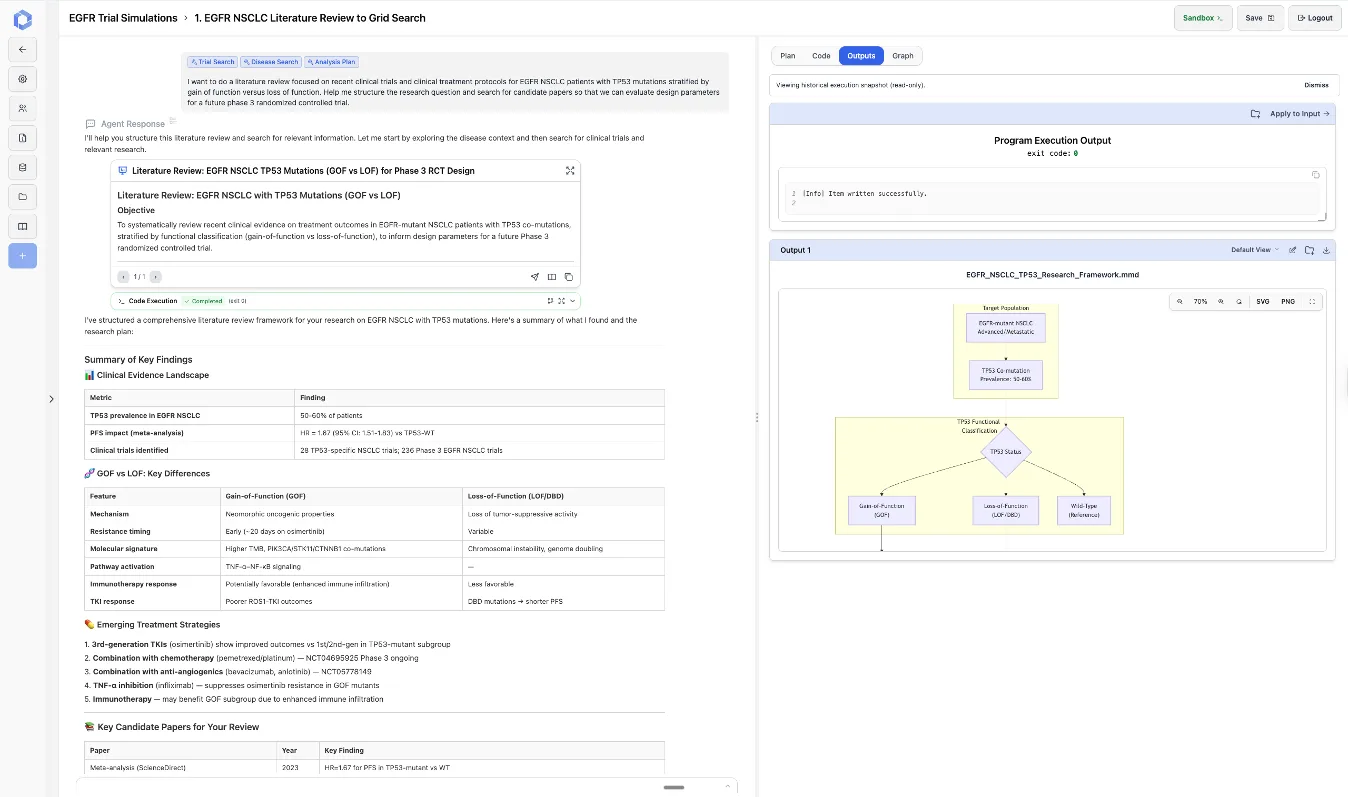
- When it is used
- Design assumptions need published evidence to support them.
- What it produces
- A research framework listing the papers that support each assumption.
A global biopharmaceutical company
Months → days
To draft eligibility criteria for a new protocol
Medical directors refine eligibility criteria using registered trials: TrialMind finds comparable trials, compares their criteria, and drafts criteria for the new protocol.
- Comparable trials found from a reference study
- Criteria compared across the matched set
- New criteria drafted and cited by trial
Customer name available under a non-disclosure agreement (NDA).
Security and data handling
Data stays in your environment
The AI components work on metadata only. Raw patient records are not moved out of your environment.
Access rules enforced by the agent
The agent cannot use data that a user is not permitted to see, regardless of how a question is phrased.
Audit trail
An unalterable audit trail, electronic signatures under FDA 21 CFR Part 11, and ALCOA+ data-integrity principles.
Technical details
- Data in
- Your SAP and specifications, raw CDISC Operational Data Model (ODM) data, and published evidence
- Outputs
- Validated SAS and R, SDTM and ADaM datasets, TFLs, estimand documents, design region
- Works with
- Python, R, and SAS, including your own code, macro standards, and templates; Clinical Data Interchange Standards Consortium (CDISC) SDTM and ADaM, define.xml, Pinnacle 21 conformance rules
- Deployment
- Inside your environment; no raw data leaves it
When the protocol changes
Every deliverable is linked to the derivation and source behind it, so TrialMind lists the affected code, specs, datasets, and tables before the work starts — within a study and across a program.
- Source dataset
- Derivation
- Table, listing, figure
- CSR section
- eCTD submission
How digital twin simulation runs
- 01Individual patient data reconstructed from published trialsDigitization, censoring, and subgroup-recovery assumptions are stated explicitly
- 02Cohort assembly and validationEvent rates checked to be adequate before anything is fitted
- 03Prognostic modeling and sample sizeThe reduction against a conventional design, quantified
- 04Sensitivity across design assumptionsEach estimate is reported with its uncertainty
- 05Applied back to the designProspective design, adaptive enrollment, or exploratory analysis
Methods and publications
Agents trained on clinical trial data rather than a general model prompted at it, with published benchmarks on clinical tasks. DSWizard (Nature Biomedical Engineering, 2026) reports a multi-step analysis workflow of roughly three months by hand completed in about a day, with a human setting the target and reviewing the results.
All publications ›See a workflow run on your study
Choose a public study, synthetic data, or your own data under a non-disclosure agreement. A 30-minute session shows the results and how they were produced.
- 1. Measured at a deployed customer, a global biopharmaceutical company, where medical directors optimize eligibility criteria against registered precedent. Named reference available under NDA.
- 2. DSWizard, Nature Biomedical Engineering, 2026: a multi-step analysis workflow of roughly three months by hand, completed in about a day with a human setting the target and reviewing results. Publications.