
TrialMind for health economics and market access
Systematic reviews with every decision recorded
Systematic literature reviews that follow the PRISMA reporting guideline, with a recorded reason for every inclusion and exclusion, reusable for each new market.
- Example GLP-1 review: records found to studies included
- 101 → 80
- Example GLP-1 review: records found to studies included
- Health technology assessment (HTA) dossier formats supported
- 5
- Health technology assessment (HTA) dossier formats supported
Evidence review and market access workflows
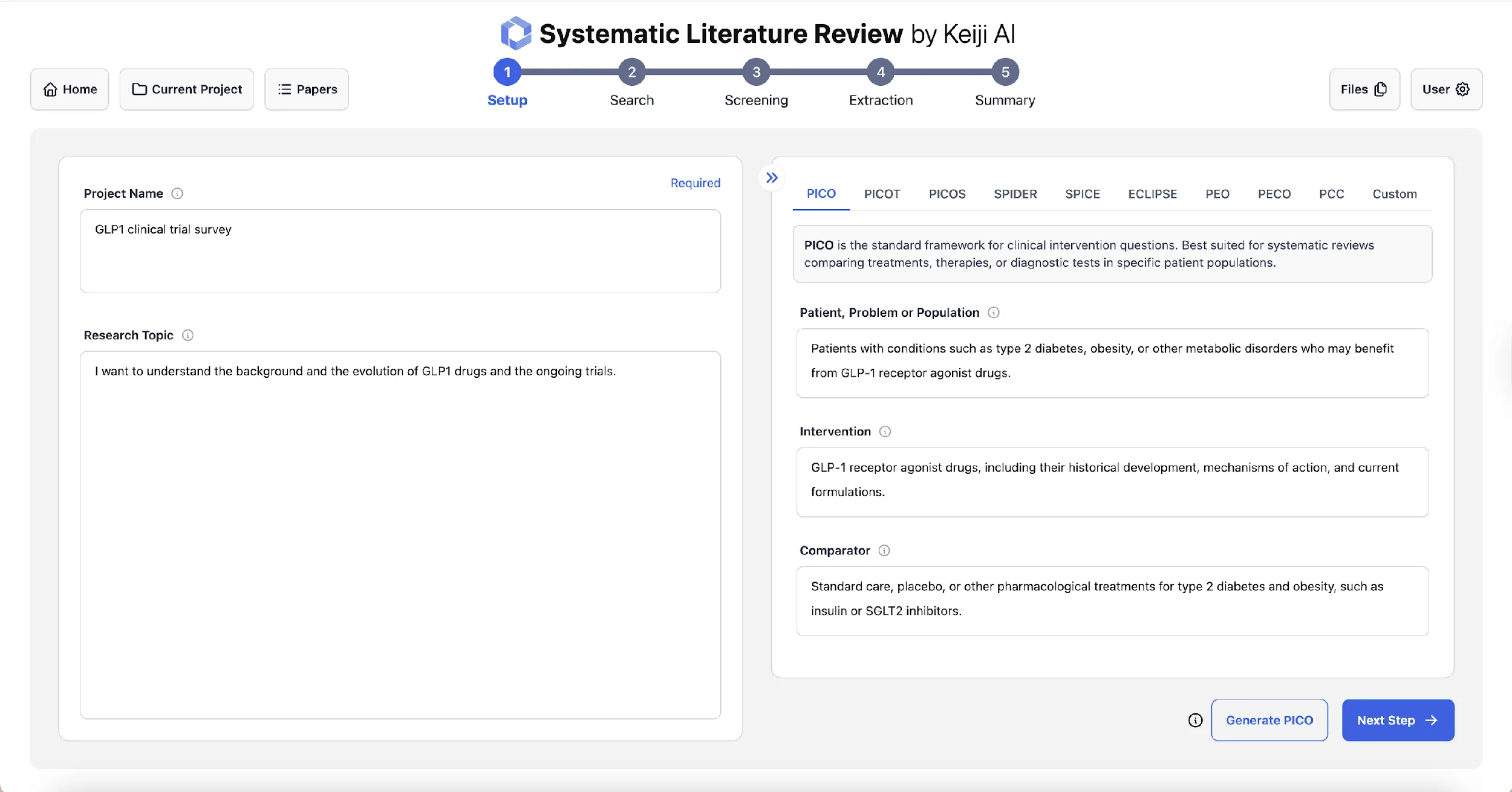
The steps of one traceable review. Each step keeps its source links through to the dossier.
- When it is used
- A new indication or market needs an evidence review.
- What it produces
- The review question defined by population, intervention, comparator, and outcome (PICO) before the search begins.
Security and data handling
Data stays in your environment
The AI components work on metadata only. Raw patient records are not moved out of your environment.
Access rules enforced by the agent
The agent cannot use data that a user is not permitted to see, regardless of how a question is phrased.
Audit trail
An unalterable audit trail, electronic signatures under FDA 21 CFR Part 11, and ALCOA+ data-integrity principles.
Technical details
- Data in
- PubMed, with date and source filters
- Outputs
- Review following the Preferred Reporting Items for Systematic Reviews and Meta-Analyses (PRISMA) guideline, risk-of-bias assessment, evidence tables, narrative sections, and indirect treatment comparisons where no head-to-head trial exists
- Dossier formats
- NICE (England), G-BA (Germany), CADTH (Canada), HAS (France), PBAC (Australia)
- Deployment
- Inside your environment; raw records are not moved
Method and publications
Screening accuracy is published and independently checkable. Compare it against your usual process on the same PRISMA output.
Frequently asked questions
Will an HTA body accept a review screened this way?
HTA bodies review the method. Every inclusion and exclusion has a traceable, reproducible reason, the output follows PRISMA, and the screening accuracy is published in peer-reviewed papers.
How is this different from the reviews our competitive intelligence team runs?
They serve different purposes. Reviews here support payer dossiers whose methods HTA bodies check; competitive intelligence reviews inform portfolio strategy and follow a different evidence standard.
Do you handle indirect treatment comparisons?
Yes. Where no head-to-head trial exists, TrialMind builds the indirect comparison and documents the method behind it, which is the part reviewers examine most closely.
What happens when we take the same product to another market?
The evidence base is reusable and updatable. A new jurisdiction means adapting to its dossier format and adding what is missing, not starting the review again.
Can it run the real-world analyses in the same dossier?
Yes. Real-world analyses run on the same platform with the same audit trail, instead of as a separate project handed between teams.
Where does our data go?
TrialMind deploys into your environment and runs where your data already lives. Raw records are not moved, which simplifies data governance and privacy review.
Compare TrialMind with your own review
Choose a review you are about to start. Run it in TrialMind alongside your usual process and compare the PRISMA outputs.