
TrialMind for Real-World Evidence
Real-world studies on your own data
Ask a study question in plain language and get the patient count, the attrition table behind it, and the analysis code, using the data you already license.
- Study types, all with an audit trail
- 7
- Study types, all with an audit trail
Real-world evidence workflows
Seven common study types. Each one reuses the same cohort definition and keeps an audit trail.
- When it is used
- The clinical team needs to know how many eligible patients exist, on a short deadline.
- What it produces
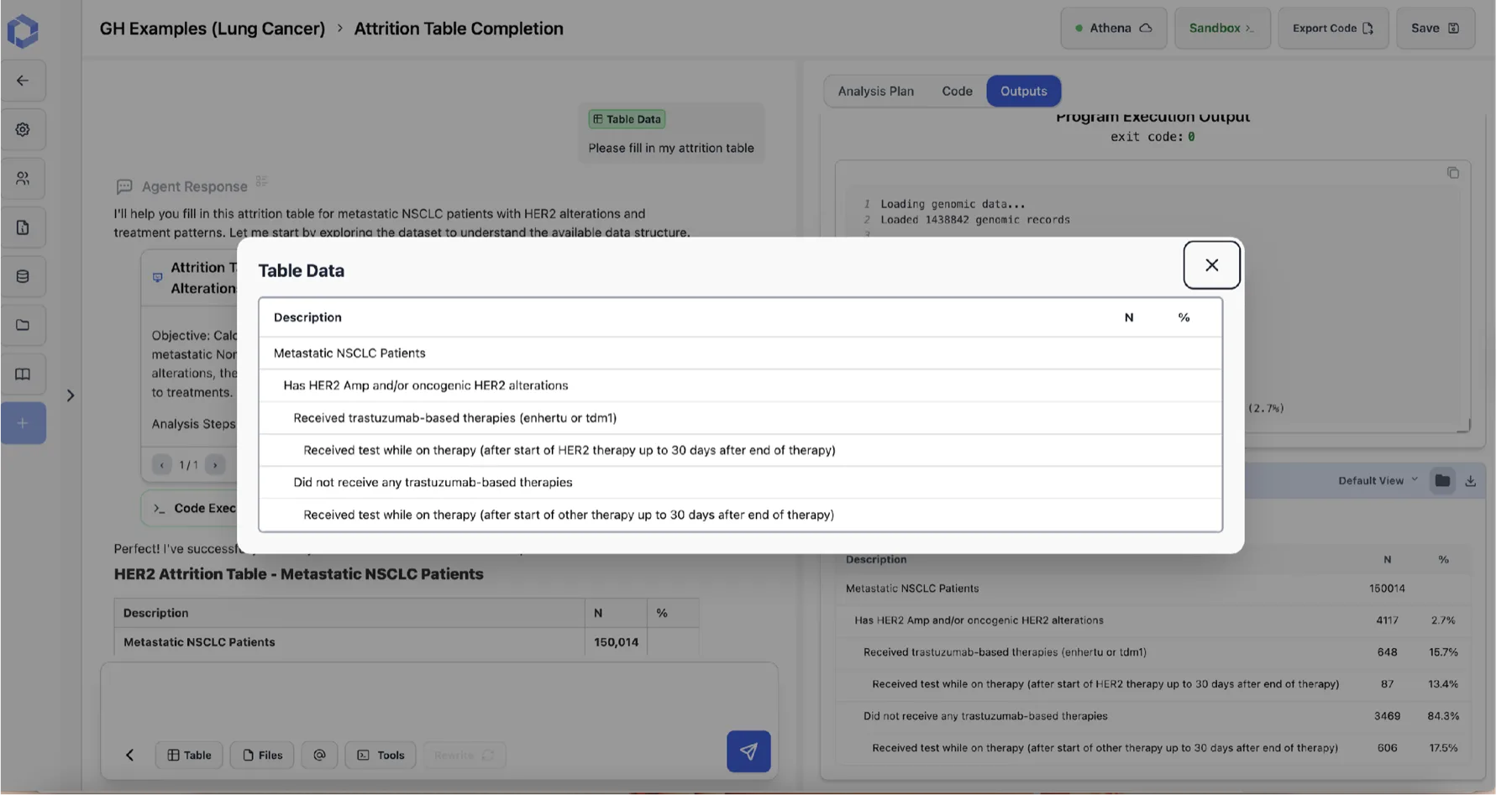
- The patient count, the attrition table showing how each criterion changed it, and the code.
A precision oncology diagnostics company
Weeks → minutes
Time to complete a feasibility study
Twenty-plus data scientists run oncology feasibility studies. They upload the attrition table they already use; TrialMind writes the SQL and returns the answer.
- Their own attrition table, no new format to learn
- SQL, Python, and R generated against their database
- Runs in their environment; data is not moved
Customer name available under a non-disclosure agreement (NDA).
Security and data handling
Data stays in your environment
The AI components work on metadata only. Raw patient records are not moved out of your environment.
Access rules enforced by the agent
The agent cannot use data that a user is not permitted to see, regardless of how a question is phrased.
Audit trail
An unalterable audit trail, electronic signatures under FDA 21 CFR Part 11, and ALCOA+ data-integrity principles.
Technical details
- Data in
- Claims, electronic health record (EHR), registry, and genomic data you already license, in the Observational Medical Outcomes Partnership (OMOP) common data model or your own schemas
- Outputs
- Analysis plan, attrition funnel, tables and figures, and SQL, Python, or R code
- Works with
- Python, R, SAS
- Deployment
- Inside your environment; analyses run where the data lives
Methods and publications
| Agent-run analysis you can check | DSWizard — reliable multi-step data-science agents for biomedical research (Nature Biomedical Engineering, 2026) · Can Large Language Models Replace Data Scientists in Clinical Research? (Nature Biomedical Engineering, 2024) |
|---|---|
| Longitudinal EHR modeling | HALO — synthesis of high-dimensional longitudinal records (Nature Communications, 2023) · PromptEHR (EMNLP, 2022) · SynTEG (JAMIA, 2021) |
| Prediction on real-world populations | MediTab — EHR pre-training for zero-shot prediction on trial populations (IJCAI, 2024) · Evidence-driven spatiotemporal hospitalization prediction (Nature Communications, 2023) |
| Comparators without patient-level access | Individual patient data reconstruction from published trials — accepted at Machine Learning for Healthcare (MLHC) 2026 |
| Population representativeness | Generative balancing for equity in medical machine learning (npj Digital Medicine, 2025) |
| Patient–cohort matching | TrialGPT (Nature Communications, 2024) — deployed at the NIH with a reported 40% average time saving |
Frequently asked questions
Do we need to buy data from you?
No. TrialMind works with the claims, EHR, registry, and genomic data you already license, so there is no additional data purchase.
Does raw patient data leave our environment?
No. TrialMind deploys into your environment and analyses run where the data already lives. Raw records are not moved, which simplifies privacy and data governance review.
Can the output support a regulatory submission?
That is what the audit trail is for. Cohort definitions, index dates, censoring rules, and analysis steps are captured and reproducible, and the methods are published so the approach can be defended by citation. The Data Science Assistant is qualified as a GxP system, with 21 CFR Part 11 and EU Annex 11 controls; formal submission analyses still run in your validated statistics environment.
Who actually runs it — an epidemiologist or a data engineer?
The epidemiologist who has the question. Natural-language cohort extraction is the point: it removes the data engineering cycle that currently sits between the question and the answer. The SQL, R, Python, and cohort definitions your team has already validated import as they are.
Why not just use a general-purpose model?
TrialMind keeps the analysis code, source references, and a record of each step together, so your team can review and repeat the work on refreshed data.
How does it handle joining claims and EHR data?
TrialMind reasons across sources rather than requiring them pre-harmonized into one warehouse. Where your data already sits in a warehouse, we connect to it rather than move it.
Try TrialMind on a study you have already run
Bring a feasibility question you already know the answer to. We run it in TrialMind, and you check the attrition table and the code.
- 1. Measured at a deployed customer, a precision oncology diagnostics company, running oncology feasibility studies on its own database. Named reference available under NDA.
- 2. An architectural property: the AI control plane operates on metadata, and analyses execute inside the customer's environment.