
TrialPanorama · npj Digital Medicine 2025
TrialPanorama: a clinical trial dataset and benchmark
A structured database of global clinical trial records, a benchmark of eight clinical research tasks, and an 8-billion-parameter (8B) model trained on the data that outperforms general-purpose models of up to 70 billion parameters (70B) on all eight.
- Global trial registries and sources
- 15
- Global trial registries and sources
- Clinical research tasks
- 8
- Clinical research tasks
- Tasks where the 8B model outperforms 70B models
- 8 of 8
- Tasks where the 8B model outperforms 70B models
TrialPanorama in the product: semaglutide, tirzepatide and the SURMOUNT-5 head-to-head trial. More TrialPanorama demos ›
Zifeng Wang1,*,†, Jiacheng Lin2,*, Qiao Jin3,*, Junyi Gao4,5, Jathurshan Pradeepkumar2, Pengcheng Jiang2, Zhiyong Lu3, Jimeng Sun1,2,†
1Keiji AI Inc. 2University of Illinois Urbana-Champaign 3National Institutes of Health 4University of Edinburgh 5Health Data Research UK
*Equal contribution †Correspondence: zifeng@keiji.ai, jimeng@keiji.ai
What TrialPanorama contains
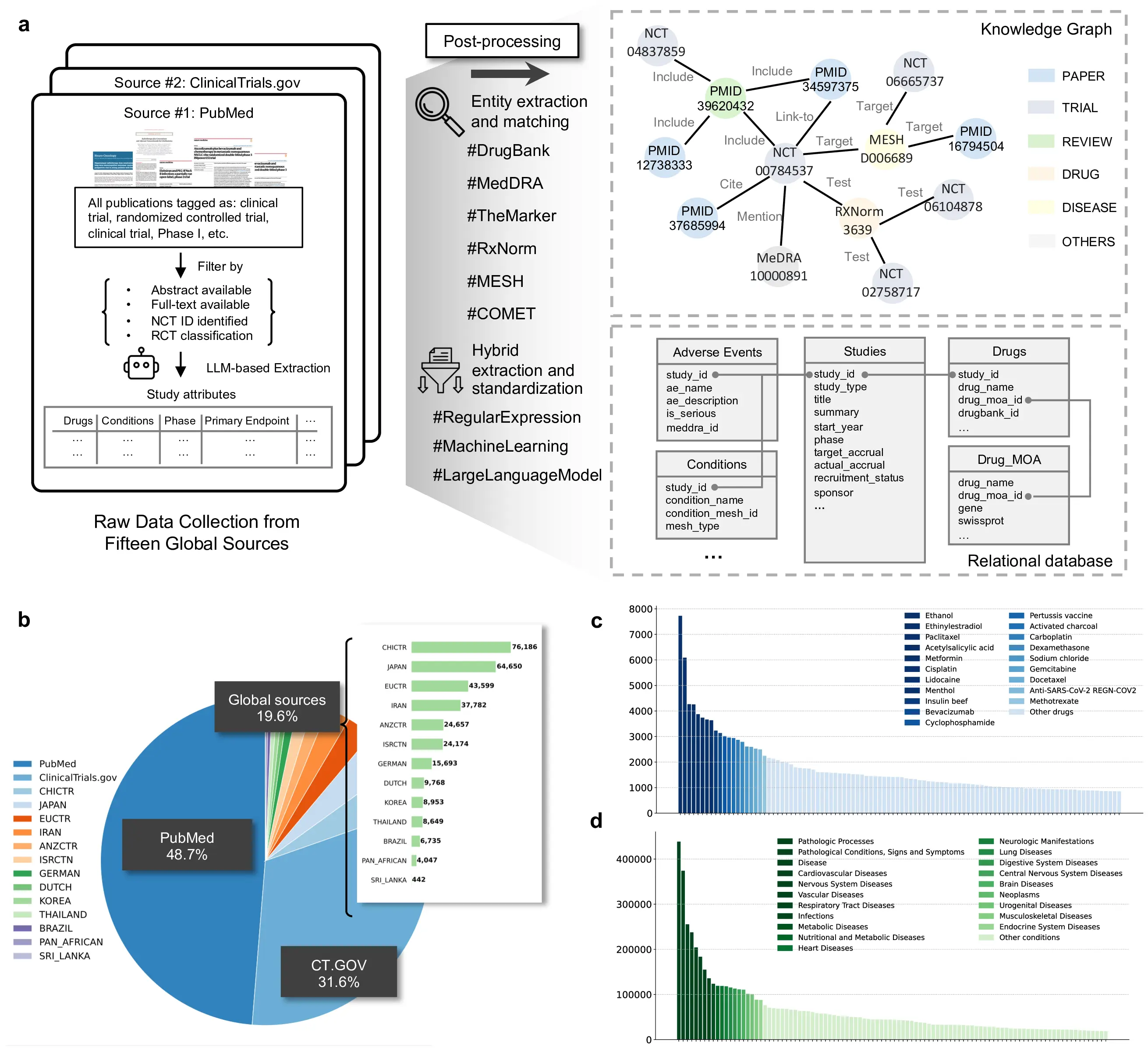
Records from fifteen sources, normalized and linked to biomedical ontologies and the literature.
Abstract
Developing artificial intelligence (AI) for clinical research requires a comprehensive data foundation that supports model training and rigorous evaluation. Here, we introduce TrialPanorama, a large-scale structured resource that aggregates 1.6M clinical trial records from fifteen global registries and links them with biomedical ontologies and associated literature. To demonstrate its utility, we build a pipeline that constructs 152K training and testing samples for eight key clinical research tasks. Three tasks support systematic review workflows, including study search, study screening, and evidence summarization. Five tasks focus on trial design and optimization, including arm design, eligibility criteria design, endpoint selection, sample size estimation, and trial completion assessment and rationalization. Benchmarking cutting-edge large language models (LLMs) reveals that generic LLMs have limited capability in clinical reasoning. In contrast, an 8B LLM we developed on TrialPanorama using supervised finetuning and reinforcement learning wins over the 70B generic counterparts in all eight tasks, with a relative improvement of 73.7%, 67.6%, 38.4%, 37.8%, 26.5%, 20.7%, 20.0%, 18.1%, and 5.2%, respectively. We envision TrialPanorama provides a solid foundation for future scaling of AI for clinical research.
Database structure: ten tables in four groups
Studies, conditions, drugs, endpoints, disposition, relations, biomarkers, outcomes, adverse events, and results.
- Trial attributes
- Core metadata: title, brief summary, sponsor, start year, recruitment status. Table: studies.
- Trial protocols
- Setup and design: tested drugs, targeted conditions, patient group allocations. Tables: conditions, drugs, endpoints, disposition, biomarkers.
- Trial results
- Reported findings: outcomes, adverse events, efficacy results. Tables: outcomes, adverse events, results.
- Study-level links
- Registry records mapped to publications, and reviews mapped to the studies they aggregate. Table: relations.
Browse the database
Benchmark tasks
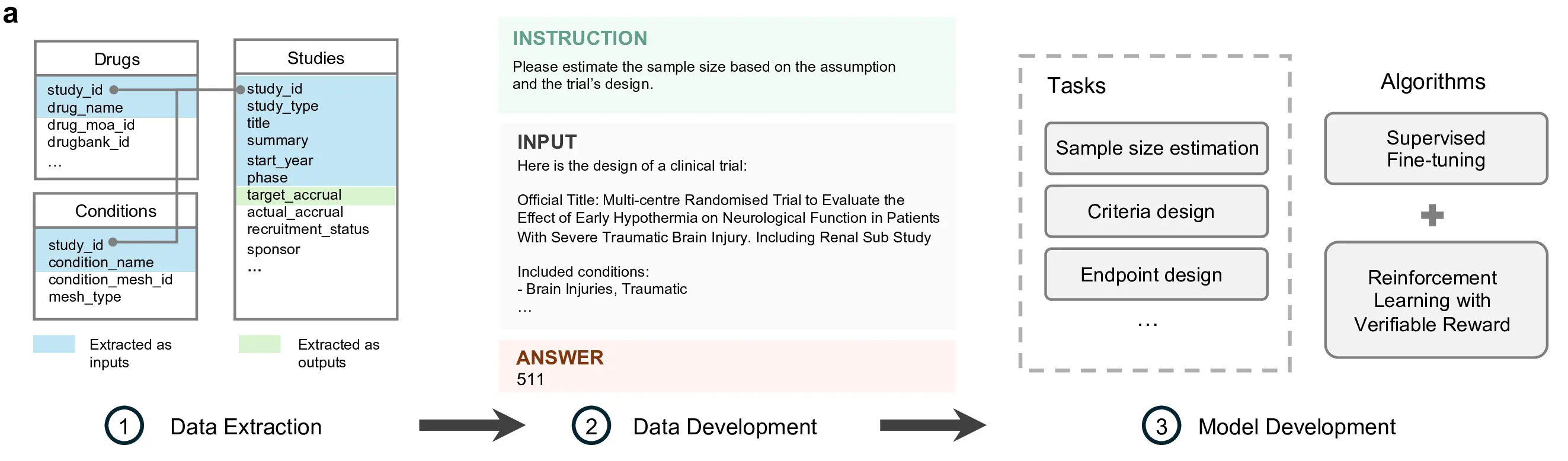
Eight tasks across two workflows, systematic review and trial design, built from real trial records and review corpora to test clinical reasoning rather than general language ability.
Systematic review
Study search
Retrieve relevant clinical trials for a research question.
Study screening
Decide whether a study meets specific inclusion criteria.
Evidence summarization
Synthesize findings across related studies.
Trial design
Arm design
Intervention and control arms with appropriate dosages.
Eligibility criteria
Inclusion and exclusion criteria for participants.
Endpoint selection
Appropriate primary and secondary endpoints.
Sample size estimation
Participant numbers required for statistical power.
Trial completion
Likelihood of successful completion, with a rationale.
Browse the benchmark
Results
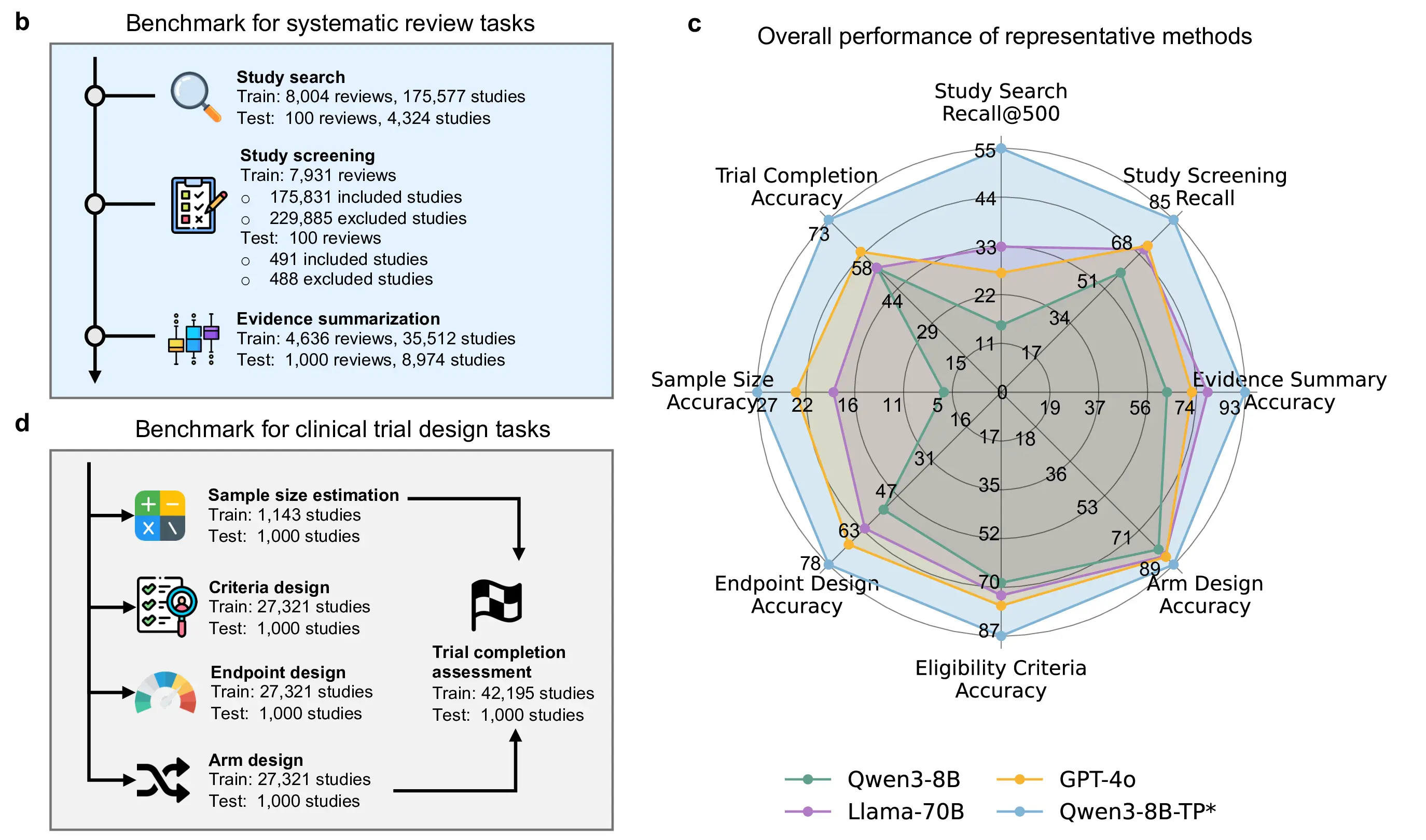
General-purpose models of up to 70 billion parameters struggle on clinically grounded tasks. An 8-billion-parameter model adapted on TrialPanorama outperforms them on all eight.
What the results show
Across all eight tasks, generic large language models show limited clinical reasoning. Even models up to 70B parameters struggle with tasks that need domain knowledge, structured trial reasoning, or several clinical constraints at once — scale alone is not enough.
Qwen3-8B-TP*, adapted on TrialPanorama with supervised fine-tuning and reinforcement learning with verifiable reward, outperforms every generic counterpart on every task, with relative improvements of 73.7%, 67.6%, 38.4%, 37.8%, 26.5%, 20.7%, 20.0%, 18.1%, and 5.2%.
Domain-aligned post-training on high-quality, task-aligned trial data matters more than brute-force scaling for clinical research.
Cite this work
@article{wang2025trialpanorama,
  title     = {Developing Large Language Models for Clinical Research Using One Million Clinical Trials},
  author    = {Wang, Zifeng and Lin, Jiacheng and Jin, Qiao and Gao, Junyi and Pradeepkumar, Jathurshan and Jiang, Pengcheng and Lu, Zhiyong and Sun, Jimeng},
  year      = {2025},
}