
TrialMind for Clinical Development & Operations
Find sites. Screen patients. Monitor trials.
Rank trial sites, match patients to trials, refine eligibility criteria, and monitor trial data, with the reasoning shown for every result.
Clinical development and operations workflows
Five workflows, from protocol design through trial oversight. Every output includes its reasoning.
- When it is used
- Trial sites need to be selected, and the Diversity Action Plan needs a documented rationale.
- What it produces
- A ranked site list that balances expected enrollment and patient diversity, with the trade-off recorded.
Human oversight and data handling
Clinical decisions stay with people
TrialMind assembles the evidence. Your medical monitor makes the decisions about patient care.
Cited reasoning
Each finding includes its source records, so monitors can check the reasoning rather than rely on a score.
Data stays in your environment
TrialMind is deployed in your environment, and patient records are not moved out of it.
Technical details
- Data in
- Protocol or ClinicalTrials.gov (NCT) identifier, patient data, historical site and investigator performance
- Outputs
- Ranked site lists (CSV files), patient screening counts, eligibility criteria drafts, enrollment and dropout forecasts, site risk scores, targeted visit agendas, data quality checks, query recommendations
- Works with
- Risk-based monitoring and key risk indicators (KRIs) per International Council for Harmonisation (ICH) E6(R2)
- Deployment
- Inside your environment; runs where patient data lives
Methods and publications
- TrialPanorama (2025) — the trial data foundation behind site and criteria analysis
- TrialGPT (Nature Communications, 2024) — patient-to-trial matching
Frequently asked questions
Does this make clinical decisions?
No. TrialMind gathers and cites the evidence behind each finding. Decisions about patient care stay with the medical monitor, and every rationale can be audited.
What happens when the analysis is uncertain?
Disagreement is surfaced to the monitor as a signal rather than averaged into one confident score. Conflicting evidence is exactly what a human should review.
How does this fit our risk-based monitoring (RBM) framework?
TrialMind can develop an RBM framework following ICH E6(R2), covering critical data elements, risks, and key risk indicators with thresholds, or work within the framework you already use.
What data does site selection use?
Historical site and investigator performance, therapeutic-area experience, and each site's patient catchment, evaluated against your protocol's eligibility criteria. You get a ranked list with reasoning attached.
Does our patient data leave our environment?
No. TrialMind deploys into your environment and runs where the data already lives, which keeps pre-screening on electronic health records (EHRs) within reach of your security and privacy review.
Try site ranking on your protocol
Share a protocol and we rank candidate sites with the reasoning shown, so you can compare the list with your own experience.
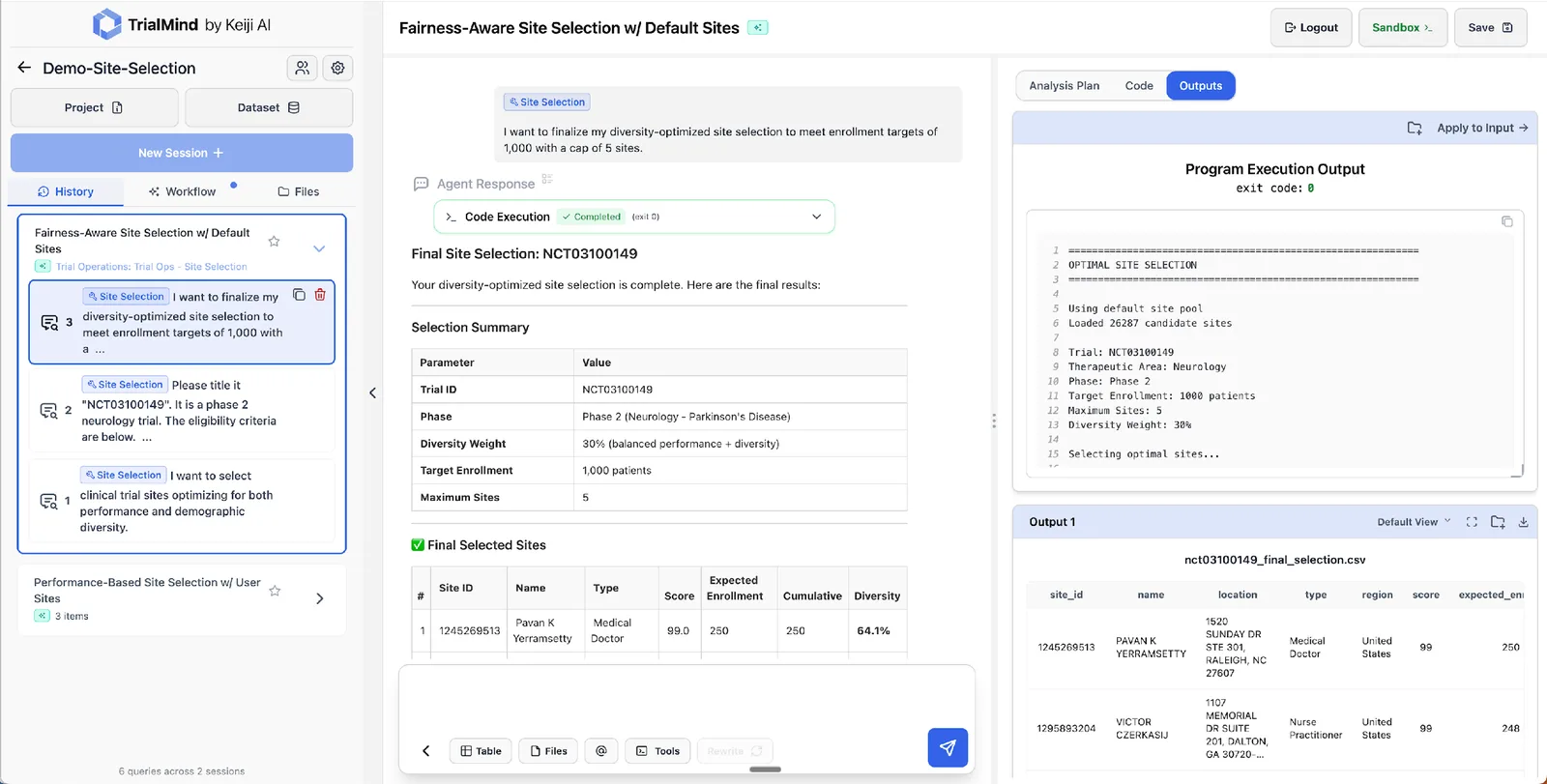
- 1. Fairness-aware site selection run on NCT03100149, a Phase 2 Parkinson's study: 26,287 candidate sites, a 1,000-patient target, and a five-site cap.
- 2. Screening run against the TROPION-Lung17 protocol: 1,001 patients to 164 candidates (16.4%), with prior treatment the largest single exclusion.